
Small Seats, Big Ideas: A Design History of Iconic Chairs and Their Miniatures
Why designers obsess over chairs, what makes the Thonet No. 14, the Windsor and Wegner’s Ming-inspired chairs so enduring, and how miniatures became design objects in their own right.
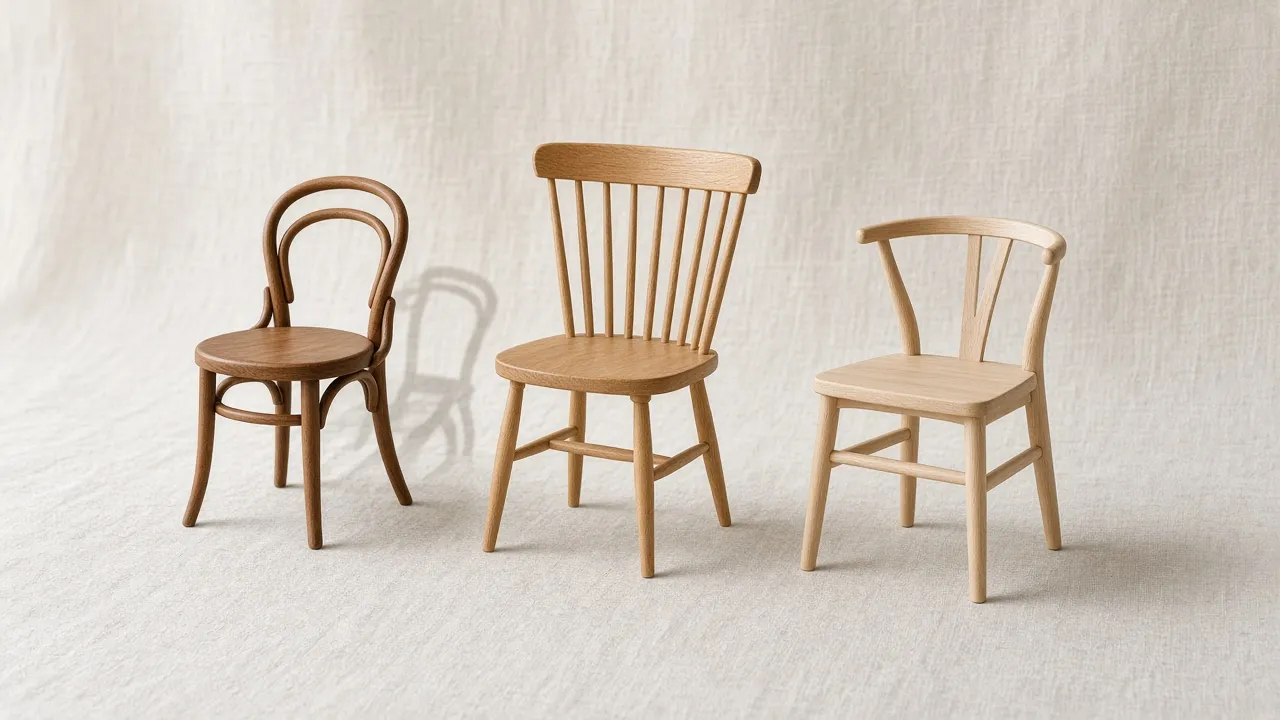
Ask a designer which object reveals the most about their craft and many will answer without hesitation: the chair. A chair must carry a body, survive years of shifting weight, be made efficiently enough to sell, and still look good empty in the corner of a room. Few objects compress so many problems into so little material. That is also why chairs, more than lamps or tables, have become the shorthand of design history — and why some of them now live a second life in miniature, on shelves and desks.
Why the chair is design’s favourite test
A chair is a structural problem disguised as furniture. The joint between seat and back leg takes the largest forces when someone leans back, and every era has answered that problem differently: with heavy carved frames, with steam-bent rods, with spindles wedged into a thick seat. Looking at how a chair resolves that one joint tells you a surprising amount about the materials, tools and economics of its time.
It is also a human-scale object. We touch a chair with our back, arms and hands, so proportion and surface matter in a way they do not for a bookcase. That combination — engineering plus intimacy — is why architects from Le Corbusier to Jasper Morrison have written about chairs with such affection.
Thonet No. 14: the chair that was shipped in parts
The Thonet No. 14, often called the Vienna coffee-house chair, appeared in Gebrüder Thonet’s first catalogue sheet in 1859. According to the Vitra Design Museum’s collection notes, it was the simplest of fourteen models: the back legs and backrest form a single bentwood arch with a smaller arch inside, joined to a caned seat ring and two front legs. The Design Museum describes the original as six pieces of wood, ten screws and two nuts.
The innovation was as much logistical as aesthetic. Beech was steamed until pliable, bent in moulds and left to dry into its new curve. Because the chair was assembled from standardised parts, it could be shipped flat — the parts for thirty-six chairs reportedly fitted into a single cubic metre — and screwed together at the destination. By 1930, around fifty million had been sold. It is a useful reminder that “industrial” and “beautiful” were never opposites; the No. 14 is light, legible and honest about how it is made.
What to look for
- Continuous curves that carry load along the grain of the bent wood.
- Very few parts — each one doing visible structural work.
- A seat that is the only flat element in an otherwise linear drawing.
The Windsor: a stool that grew a back
The English Windsor chair is built on a different logic. As the Regional Furniture Society explains, its defining feature is a thick one-piece seat — often elm — into which the legs are fitted from below and the back spindles from above. The back legs and the back are not connected; structurally the Windsor is a stool with a spindled back, held together with wedges and pegs.
Its origins lie in early-eighteenth-century England, where lightweight, portable chairs were needed for the new, more informal gardens of country houses. Early examples were painted green and known as “Forest chairs”; the Victoria and Albert Museum notes that the name Windsor probably comes from the Thames-side town that served as a distribution point. The type crossed the Atlantic and evolved into the American Windsor, and the rhythm of a spindle back has been quoted by designers ever since.
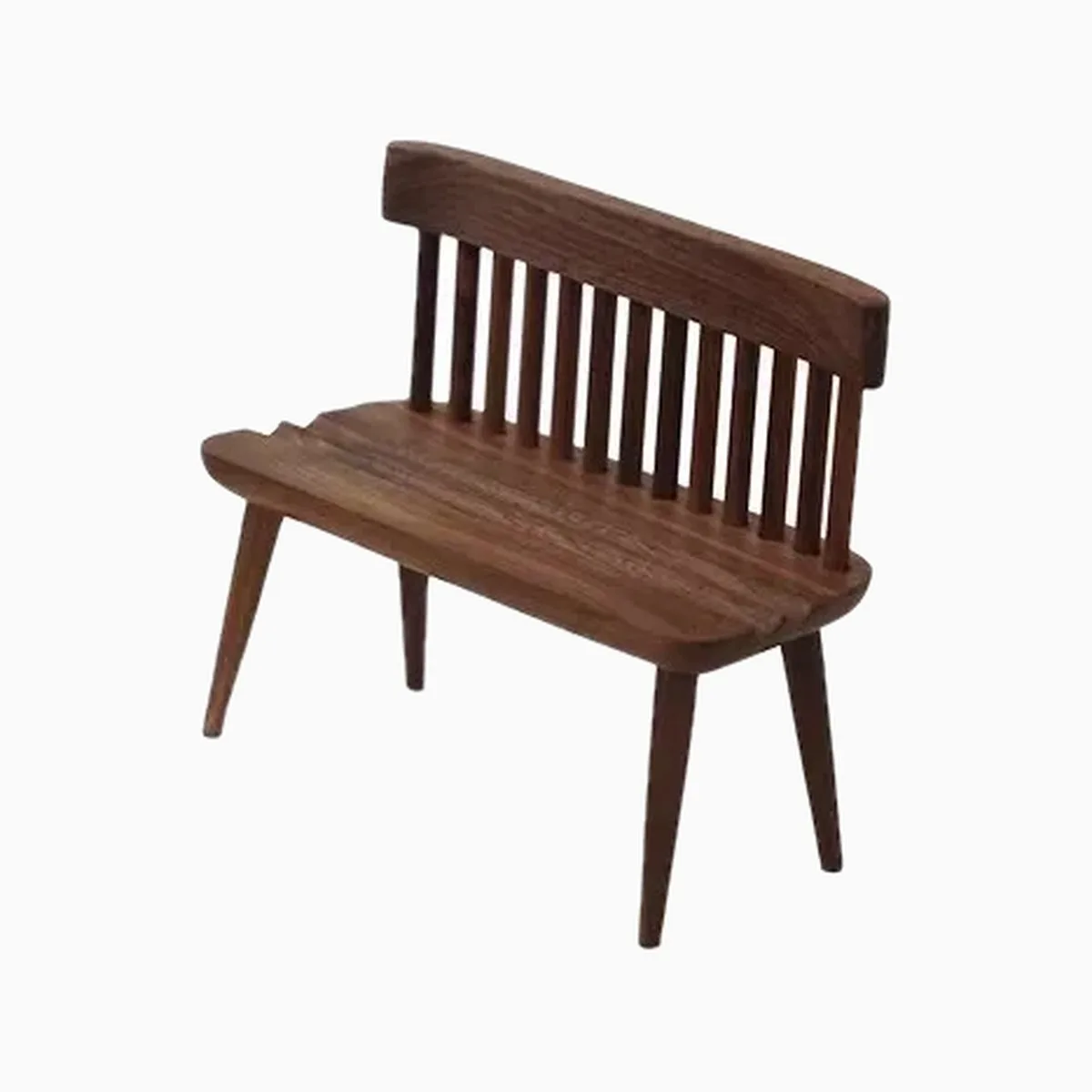
That rhythm — a row of slender verticals between a seat and a top rail — is exactly what makes a spindle back so readable at small scale. You can see it in our Walnut Chair Tablet Stand, a miniature bench whose spindles double as the support for a phone or tablet.
Ming chairs and Wegner’s “Chinese” series
Classical Chinese furniture of the Ming period is admired for frames joined with interlocking mortise-and-tenon joints, curved splats that follow the spine, and a restraint that lets the timber speak. In the twentieth century these chairs had an unexpected afterlife in Denmark. The Metropolitan Museum of Art records that in 1944 Hans J. Wegner began a series of chairs based on portraits of Danish merchants seated in Ming-dynasty chairs; the Wishbone Chair of 1949 was the last of that series and has been produced by Carl Hansen & Søn since 1950.
Wegner did not copy; he distilled. According to Carl Hansen & Søn, the CH24 is made from fourteen components, its Y-shaped back combining with a steam-bent top rail. The lineage is clear: an old structural idea, studied carefully, reinterpreted with new production methods and a lighter hand.
Why miniature chairs became design objects
Scale models have always been part of how furniture is designed. Wegner himself showed a 1:5 model of an armchair at the Copenhagen Cabinetmakers’ Guild exhibition in 1944. Since the 1990s the Vitra Design Museum has produced a Miniatures Collection of exact 1:6 replicas, including the No. 14, used by collectors, schools and architects.
A miniature strips a chair down to its idea. Without the need to carry a body, what remains is proportion, rhythm and joinery — the things we actually remember about a design. On a desk, a small chair also does something a sculpture rarely does: it invites a function. Lean a phone against its back and it becomes a stand; leave it empty and it is still a quiet reference to centuries of furniture making.
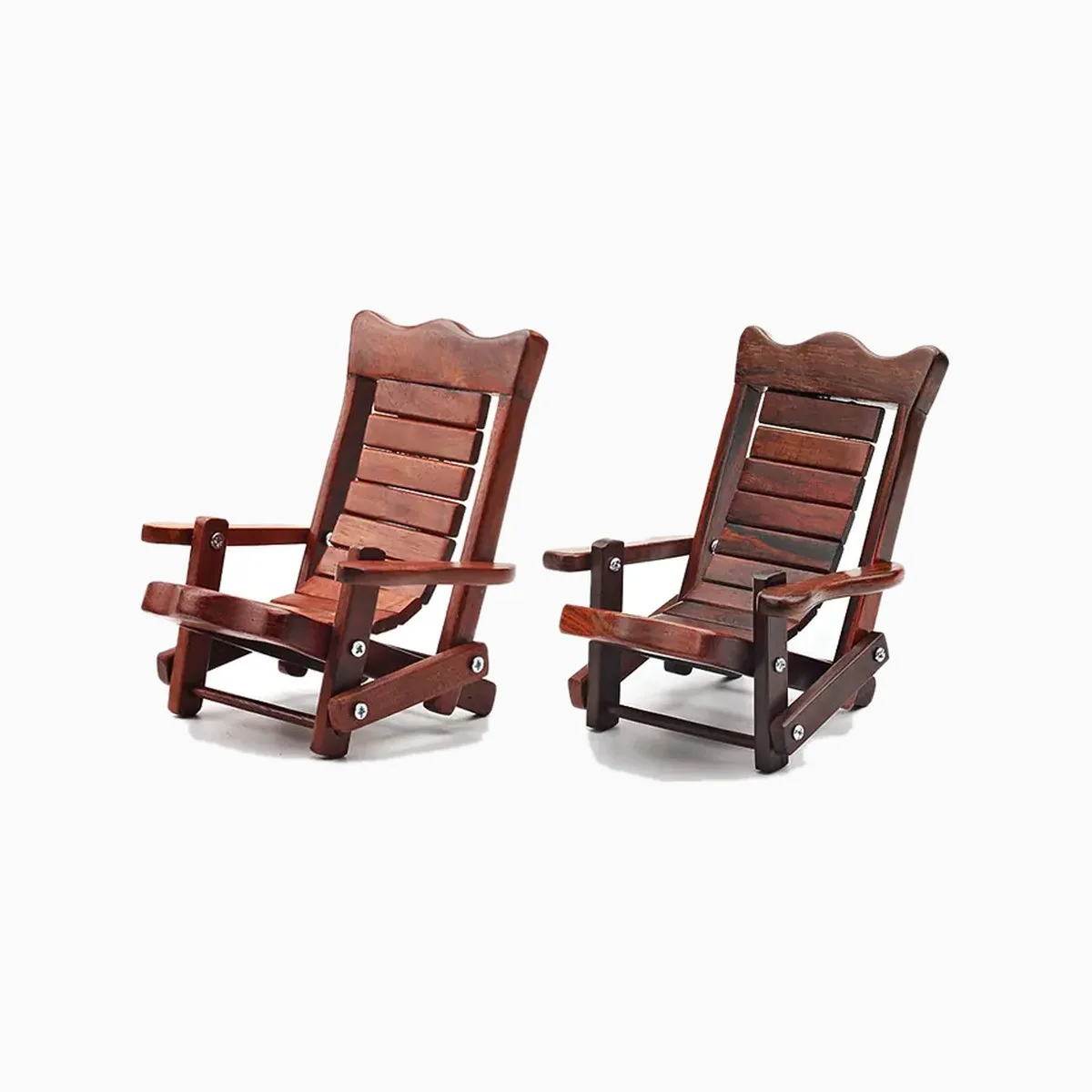
Our Chair Phone Stand – Solid Wood follows that idea with a foldable, slatted lounge-chair form in solid rosewood, while our original iPhone Stand takes the opposite route: a single flowing curve, closer in spirit to Thonet’s bent arches than to any carved frame.
How to read any chair in a minute
- Find the critical joint. Where does the back meet the seat or back leg? Bent, wedged, mortised or screwed?
- Count the parts. Fewer parts usually mean more thought per part.
- Follow the grain. Good chairs place long grain where forces run.
- Look at it empty. A great chair is still a good drawing when no one sits in it.
Whether full size or a few centimetres tall, the chairs that last are those that solve a real problem with as little as possible. That is a standard worth applying to every object on a desk.
From archetype to desk object: what changes at small scale
Shrinking a chair is not just a matter of dividing every dimension. At full size, a seat must be around 45 centimetres high and wide enough for a person; at desk scale, those constraints disappear and new ones appear. The object has to be stable under a phone that is heavy relative to its own weight, its back must sit at an angle that suits a screen rather than a spine, and every edge will be seen from a few centimetres away. Details that a full-size chair can hide — the end grain of a slat, the head of a screw — become the first thing you notice.
That is why the best miniatures concentrate on the elements that define the type. A Windsor at small scale is its spindles; a Thonet is its unbroken arch; a lounge chair is its reclined, slatted back. Remove those and the object becomes generic. Keep them, and even a piece a hand’s width tall carries the memory of the original.
Collecting with an eye for detail
If you are drawn to miniature furniture, look for the same qualities you would expect in a full-size piece: solid wood rather than printed surfaces, joints that are visible and tidy, and proportions that still feel right when you look at the object from the side. A good miniature should be satisfying to pick up, not only to photograph.
Frequently asked questions
Why is the Thonet No. 14 so famous?
Introduced in 1859, it combined steam-bent beech, a small number of standardised parts and flat shipping, making an elegant chair affordable. Around fifty million were sold by 1930.
What defines a Windsor chair?
A thick solid-wood seat into which the legs are fitted from below and the back spindles from above, so that the back is not connected to the back legs.
Which chairs inspired Hans J. Wegner’s Wishbone Chair?
Wegner developed it as the last of a series begun in the 1940s that was inspired by Ming-dynasty Chinese chairs.